Established evidence
Guidance supported by a substantial body of research or public-health recommendations.
My Approach
Health investigation begins with your story. We look at physiology, personal experience, behaviour and environment together, exploring possible causes, contributing factors and practical next steps.
My approach at YOVANwell is informed by naturopathic principles and centered on the whole person. I consider nutrition, lifestyle, emotional wellbeing and personal circumstances together, helping people understand their patterns and explore practical changes suited to their individual needs.
The protocol begins with the person—not the category.
The YOVAN approach
Begin with what you need today. Explore nourishment, feelings, purpose, breathing room and awareness.
Find your starting point
Choose a theme to explore
Foundations & nourishment
Food, rest, everyday rhythms and feeling supported. Start with a foundation that is realistic for your life.
A moment to reflect
What would help you feel more grounded today?
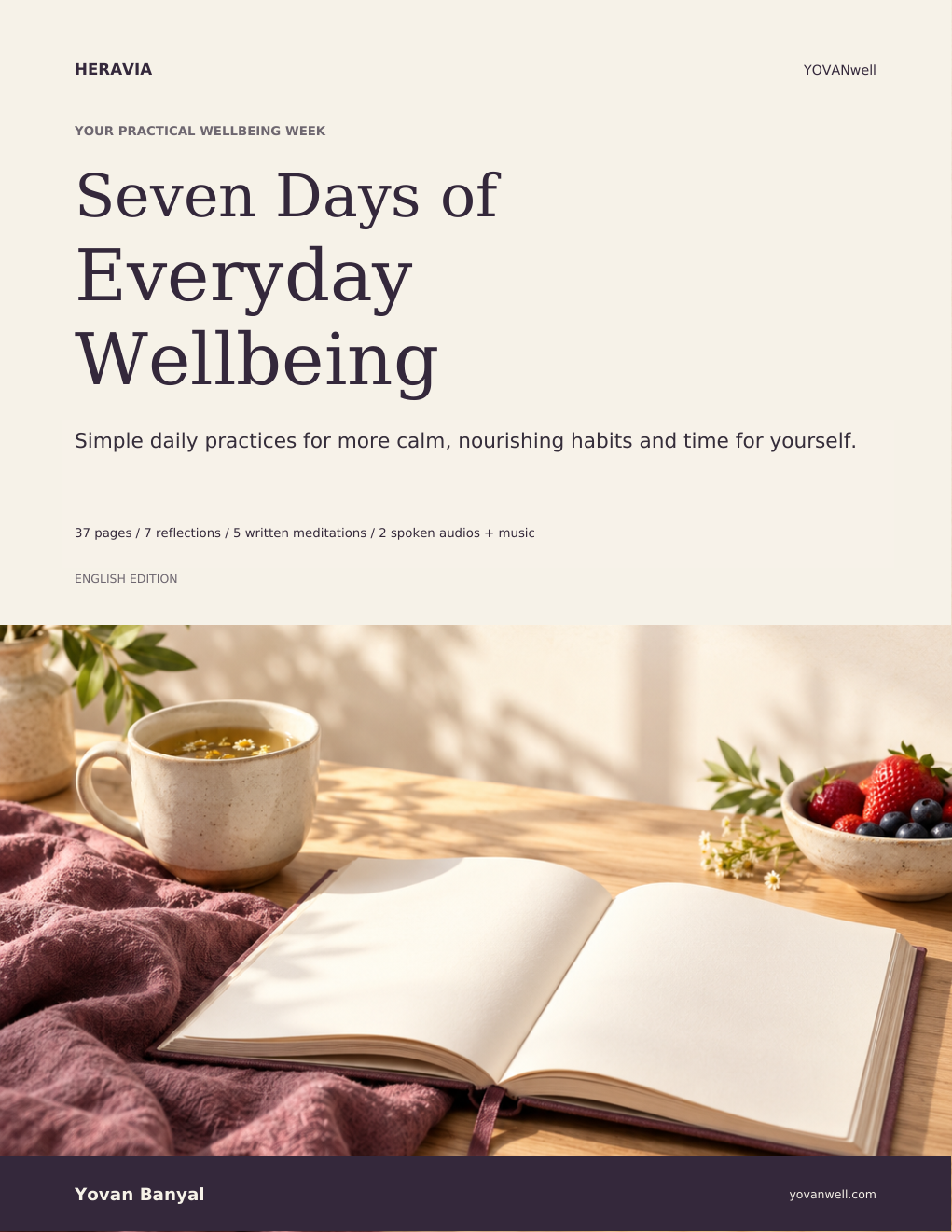
A practice from Seven Days of Everyday Wellbeing
Put your phone aside for the first five mouthfuls.
Explore this day in the programmeThe elements are inspired by nature and offer prompts for reflection and everyday care.
Explore small daily practices with Seven Days of Everyday Wellbeing, or bring your own questions to a personal consultation.
A moment with Yovan
A personal introduction to the thinking behind the petals and whole-person care.
Yovan BanyalHolistic Health Practitioner · Author & Wellbeing Educator10 years of practice in alternative medicine.
 Professional affiliation · CAT 2026
I begin by listening to how you feel, what your days are like and what matters to you. Your body, feelings, habits and circumstances all deserve attention. The petals represent nourishment, rest, kindness, purpose and space to pause. Together, we explore what deserves attention and choose a practical next step that fits your life.
Your life. Your needs. Your pace.
Begin where you are
You do not need to know what is causing it.
Start with what you are noticing. We can look at the wider picture together and explore the patterns, connections and influences that may be worth understanding.
Not sure where to begin? Your story is the starting point.What we can explore
Fatigue, disrupted sleep, digestive changes, reduced resilience or simply a sense of imbalance. We begin with what has changed and explore which connections deserve attention.
Explore your consultationWhat we can explore
We can explore sleep, nutrition, stress load, metabolism, recovery, daily rhythm and other relevant influences. We look at the pattern over time rather than assuming one cause.
Explore your consultationWhat we can explore
We explore how nervous-system regulation, emotions, lifestyle and physiology may interact, and what your circumstances allow you to change.
Explore your consultationWhat we can explore
We explore patterns across body, mind and daily life to build a clearer picture of what may deserve attention. Your history, experiences and questions help shape the investigation.
Explore your consultationThe person comes first. The category comes second.
Sleep can influence energy. Stress can affect digestion. Nutrition, mood and metabolism belong in the wider picture, alongside hormonal patterns, behaviour and daily circumstances.
Rather than assuming one explanation, we look at the relationships between the pieces. The aim is to understand your individual pattern more clearly, identify what deserves attention, and decide what the most useful next step may be.
Explore your consultationChoose a perspective when you would like to look more closely. Each offers a different way into the conversation.
Body, Mind, Life and Inner Self offer four perspectives on your story. Awareness surrounds them: noticing how your experiences and patterns connect. You remain at the centre.
Choose a dimension to explore it.
Noticing · Recognising patterns · Understanding · Conscious choice
Awareness connects the four perspectives. It means noticing sensations, thoughts, feelings and recurring patterns with curiosity, creating space to choose how to respond.
A question to explore
What am I noticing, and what might I be overlooking?
The protocol begins with the person—not the category.
Select a connection to explore the questions it raises. This map is educational, not a diagnostic tool.
Stress responses involve nervous-system and hormonal signalling. Sleep and daily rhythms also relate to hormone patterns.
The questions below reflect my investigative approach, not a diagnostic checklist.
One symptom does not establish a hormonal cause. Feeling stressed does not tell us your cortisol level.
A timeline of changes, sleep patterns, medicines and any relevant existing medical results can guide the discussion.
Sources for the general relationship (English)
Hormonal signalling helps regulate how the body uses energy. Appetite, weight and sleep also have multiple influences.
The questions below reflect my investigative approach, not a diagnostic checklist.
A weight change or one laboratory value rarely explains the whole picture. Results need clinical context.
The timing and pace of change, family history, medicines and existing relevant tests help us identify useful questions.
Sources for the general relationship (English)
Food choices, portions, meal timing and activity matter to metabolic health. A useful plan also considers sleep, medicines and individual needs.
The questions below reflect my investigative approach, not a diagnostic checklist.
Low energy is not proof of a nutrient deficiency. One food or calorie count cannot explain every metabolic concern.
A brief food-and-routine record, existing dietary advice and relevant health history can help. New tests are considered only when appropriate.
Sources for the general relationship (English)
Gut microorganisms help process food and interact with our bodies. Research is still developing on how to turn microbiome findings into personalised advice.
The questions below reflect my investigative approach, not a diagnostic checklist.
Digestive symptoms do not by themselves prove a microbiome imbalance. There is no universal probiotic or ideal microbiome for everyone.
The symptom timeline, food tolerance, medicines and relevant medical assessments help put digestive changes in context.
Sources for the general relationship (English)
Microorganisms interact with immune responses. What this means for a particular symptom or treatment depends on the condition and the evidence.
The questions below reflect my investigative approach, not a diagnostic checklist.
A broad biological connection does not prove that gut treatment will resolve an immune condition.
An accurate history of infections, allergies, medicines and medical findings helps identify questions for your treating clinician.
Sources for the general relationship (English)
Sleep supports attention and memory, while stress can disrupt sleep. Daily rhythms and opportunities to rest form part of the picture.
The questions below reflect my investigative approach, not a diagnostic checklist.
Poor sleep is not automatically a stress problem. Persistent symptoms may need assessment for a sleep disorder.
A short sleep diary, daytime symptoms, medicines and observations from someone who shares your sleeping space can help.
Sources for the general relationship (English)
Physical activity contributes to metabolic health, including blood-glucose management. The type and amount need to fit the person.
The questions below reflect my investigative approach, not a diagnostic checklist.
More exercise is not always the right first step. Pain, prolonged worsening after activity or medical restrictions need individual attention.
Your baseline activity, recovery pattern, mobility and existing medical advice help us choose a realistic starting point.
Sources for the general relationship (English)
Stress can affect sleep and everyday functioning. We explore how pressures, coping responses and routines fit together in your life.
The questions below reflect my investigative approach, not a diagnostic checklist.
A missed habit is not evidence of weak motivation. A physical symptom should not be dismissed as “just stress.”
Patterns around work, meals, rest and relationships can identify practical constraints and support worth discussing.
Sources for the general relationship (English)
Where you live and work shapes access to food, movement and rest. Health advice needs to account for these real conditions.
The questions below reflect my investigative approach, not a diagnostic checklist.
Timing alone does not prove an environmental cause. We should not infer a toxin or exposure from nonspecific symptoms.
A timeline of changes and an account of your work, living conditions and available resources can help us set achievable priorities.
Sources for the general relationship (English)
These relationships do not mean that every symptom has one hidden root cause. They mean health is complex enough to deserve context.
YOVANwell does not present every idea as if it carries the same scientific weight. We distinguish between what is well established, what is still developing, what comes from traditional practice and what represents practitioner interpretation.
Guidance supported by a substantial body of research or public-health recommendations.
Early or developing findings, with uncertainty and limitations made explicit.
Historical use or a cultural framework; this alone does not establish medical effectiveness.
A reflective or practical viewpoint, distinguished from a research finding.
The connection summaries describe general relationships. The questions are my way of exploring your context; they are not diagnostic rules. A source supports its stated topic, not every possible interpretation.
Yovan Banyal
I do not begin by trying to prove a theory. I begin by asking:
Sometimes the answer is biological. Sometimes behavioural. Sometimes environmental. Often it is a combination.
The goal is not to make the person fit a model. The goal is to make the model fit the person.
Once we have a clearer picture, we decide what deserves attention first. The next step should be specific, realistic and personal.
Ayurveda, acupuncture knowledge and other complementary approaches may inform discussion. Vitalfeld or bio-field sessions, when offered, are complementary wellbeing practices. They do not diagnose organ function or replace validated medical tests, treatment or prescribed medication. Evidence and suitability vary; we discuss this before agreeing any approach.
Programmes
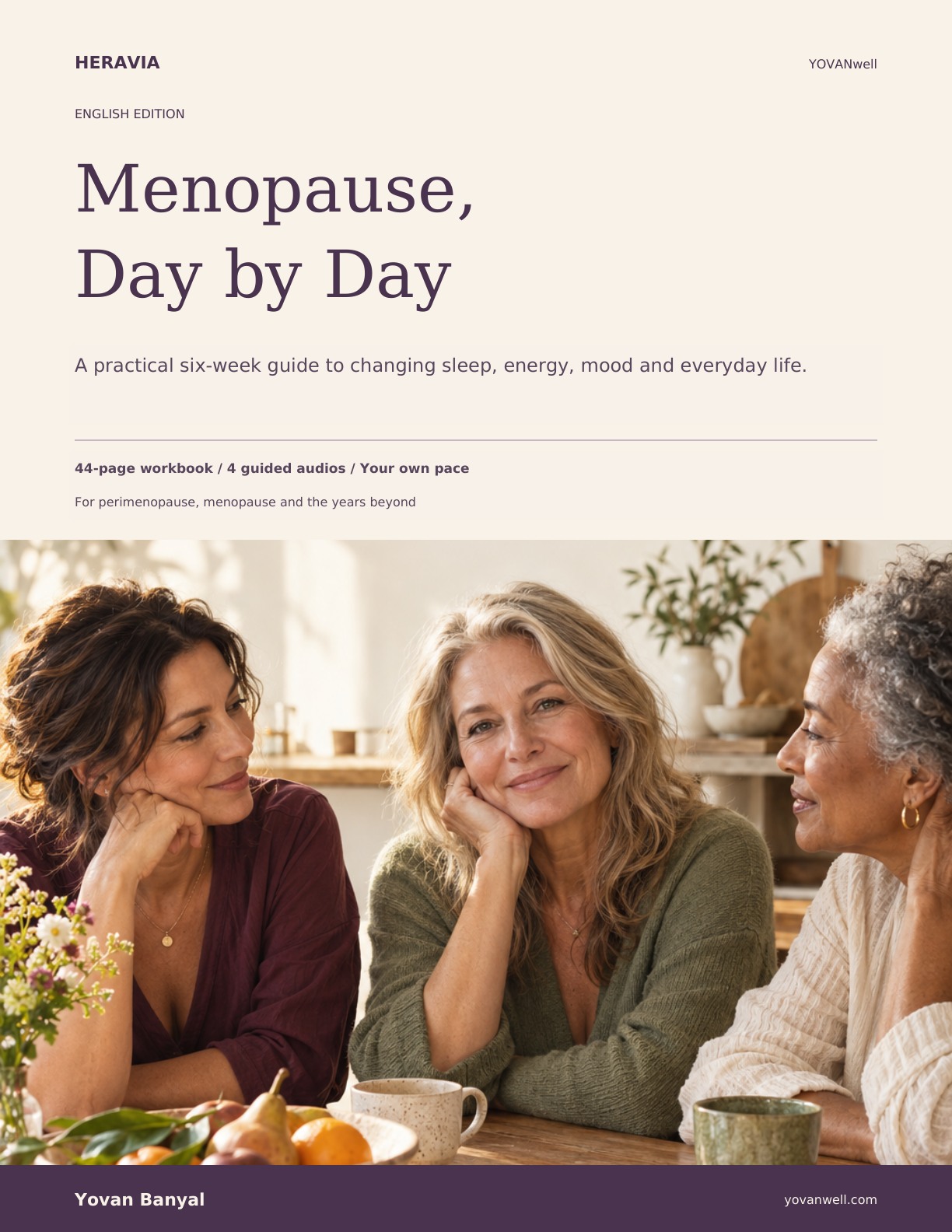
Explore a guide you can follow at your own pace. Choose a manageable week or support through menopause, and look inside before you decide.
Explore all guides and recordingsA consultation connects your experience with a careful review of the information available. We explain and agree the approach as we go.
What are you noticing, when did it begin, what has changed and what would you like to understand?
We consider relevant health history, sleep, nutrition, stress, daily circumstances and existing health information.
Discussion, observations and appropriate assessment methods. In person, equipment may be included after we discuss suitability and you agree.
We bring the pieces together, explain possible connections, separate observations from interpretations and identify unanswered questions.
We agree practical priorities, explain why they matter and discuss how any further support would work.
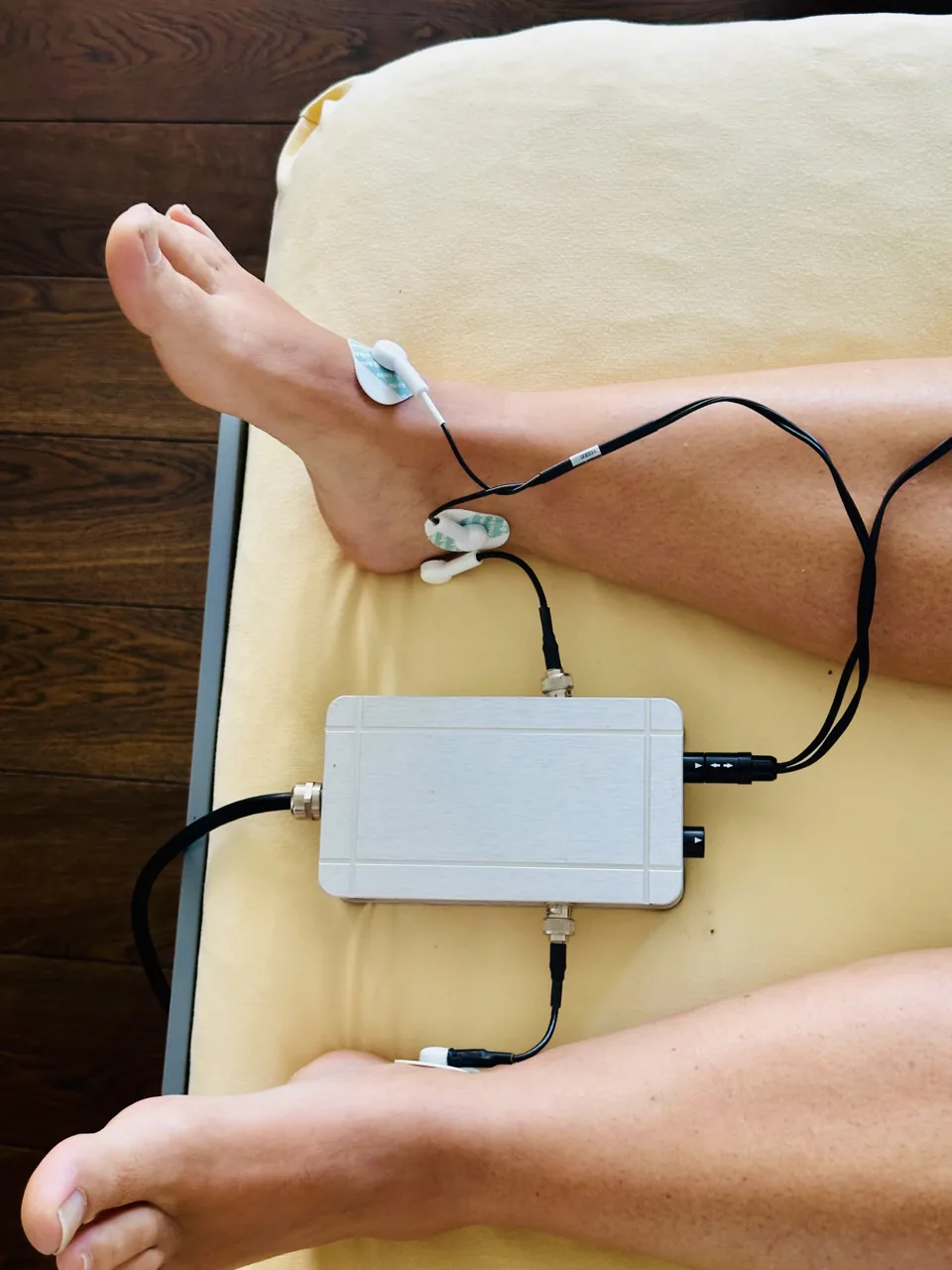
In-person sessions · Global Diagnostics
During in-person sessions, I use Global Diagnostics by VITATEC as part of my complementary assessment approach.
My intention is to explore further questions and consider perspectives beyond the conversation alone. We review the device’s readings together, alongside your experiences, health history and any relevant medical findings.
I explain how I interpret the information, what remains uncertain and which questions deserve further attention. The person’s story remains central throughout.
Global Diagnostics uses VITATEC’s Vitalfeld approach. This method is not scientifically established for diagnosing disease. Its readings do not replace medical examination, laboratory tests or other validated investigations.
Bring your main questions, a list of medicines and supplements, and relevant reports you already have. You do not need to arrive with a diagnosis or arrange new tests for the first conversation.
Both formats centre on your story, explanation and agreed priorities. Online sessions use conversation and information you share; Global Diagnostics assessment requires an in-person appointment.
We discuss the next steps during your consultation. Any written summary, personal protocol, YOVAN Care access or follow-up support is agreed explicitly; these are not automatically included with every appointment.
View the booking calendar or send a request to discuss your consultation.
Looking deeper, understanding together