
Welcome to your programme
Menopause, Day by Day
Your paid workbook and full recordings are available through your purchase receipt. This starting guide and complimentary companion help you put them to use.
Your starting point
Find a beginning that fits today.
Two optional choices suggest a place in the workbook. You can change your focus or follow the full programme whenever you wish.
Your choices stay on this page. They are not sent to us or saved as a profile.

A note from Yovan
Begin where you are.
This chapter can bring different needs, questions and feelings. You do not have to work through everything at once. Begin with what is hardest in your everyday life, choose a manageable action and make room for the support you need. I hope these pages help you find words, practical options and a pace that feels like your own.
Yovan Banyal
Meet YovanYour first few minutes
- 01
Download the pack from your receipt, unzip it and choose your preferred language.
- 02
Open the quick start. Save a personal copy of the workbook before adding notes; test one entry in a compatible PDF reader.
- 03
Choose one useful practice and a realistic time for it. Your companion gives you a simple place to plan.
Worked examples
See what a small beginning can look like.
Illustrations to help you use the pages in your own way. Each example is fictional; it is not a testimonial or a promised result.
01Make a weekly plan that fits real responsibilities
Fictional illustration
A fictional participant has work and caring responsibilities and wants a more manageable evening.
Week 3 and the reusable weekly planner
- My priority
- Make the last part of the evening less crowded with tasks.
- One practical action
- After dinner, prepare one thing for tomorrow and decide which remaining task can wait.
- A support request
- Could you take care of dinner on Tuesday so I can have a quieter evening?
- An easier version and review
- On a demanding day, write one task that can wait. At the weekend, review whether the plan was realistic.
02Prepare clear questions for a care conversation
Fictional illustration
A fictional participant wants to explain changing sleep and its effect on ordinary days. These notes organise a conversation; they do not establish a cause.
Consultation tools and the completed example in the main workbook
- What I want to explain
- Over the past few weeks, waking at night has made concentrating at work harder.
- A specific example
- On two mornings last week I needed to postpone a demanding task after a disrupted night.
- Questions I will bring
- What could be contributing? Which support options fit my history and preferences? When should we review the plan?
- My next step
- Arrange a suitable appointment and bring the short notes I choose to share. Follow the workbook’s care guidance when needed.
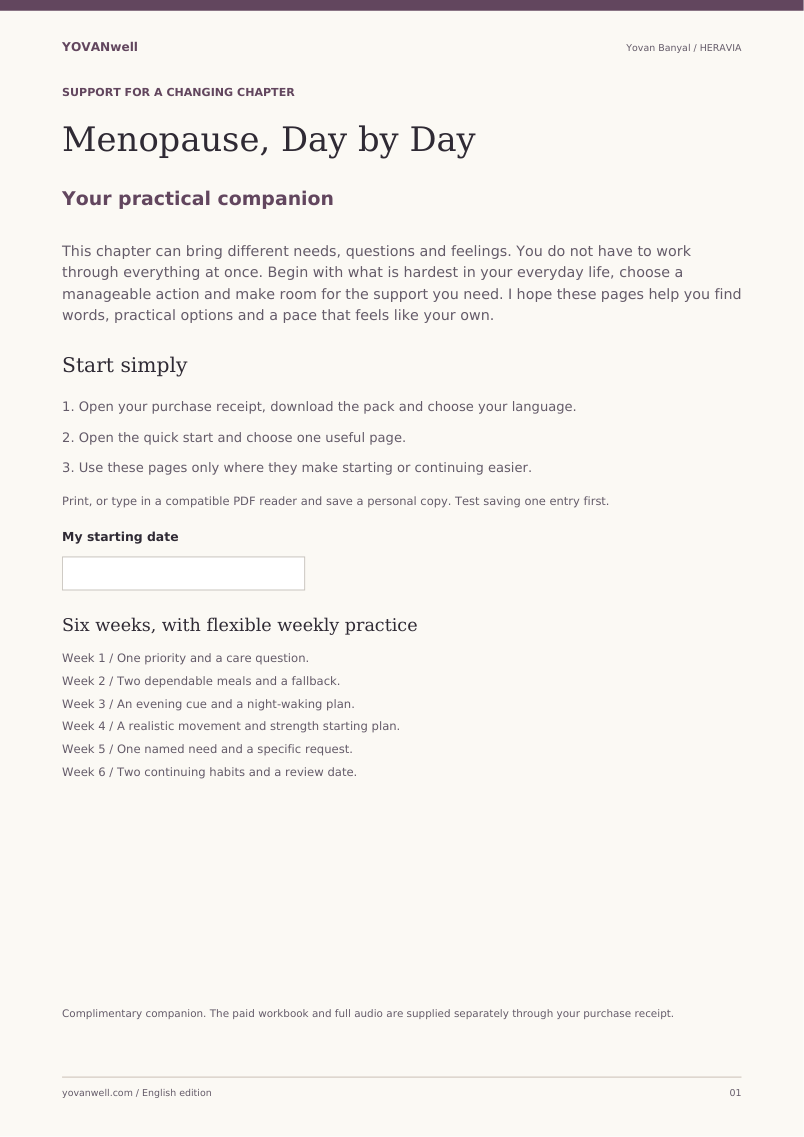
Your practical companion
A little structure for the days ahead.
A complimentary printable companion with a welcome, simple planning pages and room to choose what you will continue. Use it alongside your programme.
Six weeks, with flexible weekly practice
A little encouragement to return to
Understand your needs and choose a priority
Begin with one priority. The programme can follow the needs of your own week.
Make nourishment dependable
Choose what makes a meal more dependable and practical for you.
Support sleep and recovery
Notice what supports rest and what demand could be shared or simplified.
Build everyday strength and movement
Choose a movement plan that fits your capacity and existing care advice.
Understand emotions and ask for support
A clear request for support can begin with: “What would help me is…”
Keep what helps and plan your next steps
Keep what is useful, review what needs adapting and make room for appropriate care.
Make room for what helped.
Keep one useful practice. Give it an ordinary cue, choose an easier version for difficult days and set a date to review it. The companion includes a plan you can reuse.
Download the companion